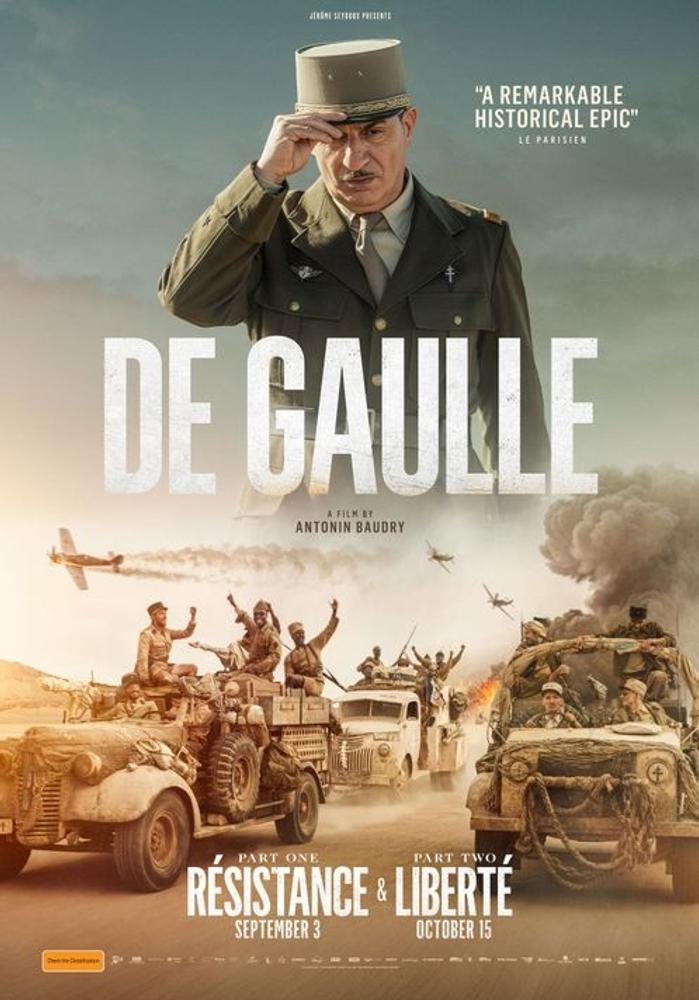
I loved this movie. It’s the first of a two-part biopic about Charles de Gaulle and the role he played in World War II. It starts with the collapse of France in June 1940 and covers the two years until a major turning-point of the war in June 1942. The second part, to be released next month, takes us from that mid-war turning-point to the eventual allied victory and France’s liberation. It is called, unsurprisingly, De Gaulle: Liberte.
The French seem to be going through a phase of belatedly recognising the role played by De Gaulle in his country’s wartime history. In 2020 a film was made simply titled De Gaulle, which I saw and reviewed (see here) and which has an even shorter time-line. It only covers the period from the French capitulation to De Gaulle’s flight to England, from where he famously delivered an address on the BBC declaring himself the true leader of France and calling on his countrymen to continue to fight. The point of the movie seemed to be to depict De Gaulle’s speech as having a similar spine-stiffening effect on the French as Winston Churchill’s fight-them-on-the-beaches oratory had on the British. It doesn’t entirely succeed. In the oratorial stakes it’s a lay-down misere for Churchill. Which is not to say De Gaulle’s speech was of no consequence. He was declared a traitor because of it and summoned back to France to face the music, which of course he didn’t do, and stayed on in England to rally the Free French in exile.
This new film takes up the story from there, dealing first with his struggle to rally the French people with no money and no army and almost no friends. Churchill admires De Gaulle’s defiant spirit and gives him office space to establish a resistance headquarters, but his cabinet is contemptuous, sneering at the rapidity of the French surrender and De Gaulle’s failure to rally even those French soldiers still in England.
It probably helps to be a history buff like me, but De Gaulle: Resistance works both as suspenseful wartime history and as personal drama. The turbulent relationship with Churchill is engrossing, as are the efforts of both of them to entice US President Franklin D Roosevelt into the war against the Nazis. Curiously, when Churchill tells De Gaulle that the yanks are in at last, it’s because ‘the Germans have declared war on America’, but there’s no mention of Pearl Harbour!
But then, this is a film from the French perspective. There’s a lot of history I didn’t know, in particular how De Gaulle shifted his efforts and his headquarters to North Africa, concentrating on recruiting France’s African colonies to the cause. This part of the story is not just about the politics, and it’s thrillingly told. The Free French soldiers, few in number, never know who to trust, who’ll support them, who might turn on them and whether they might even have to end up killing people who are technically French citizens in order to survive.
There’s a sub-plot about a young French patriot who joins a group of fellow students plotting resistance to the Nazis, one of them a young woman. There’s a budding love story, but there’s also extreme danger. They climb up on a roof and flood Paris with leaflets calling for a rally, narrowly escaping German soldiers who’ve spotted them. A surprisingly big crowd of protesters turns up, but so do the German soldiers, brutally putting an end to that brief moment of hope and exhilaration. There’s dispersal, escape, and a suspenseful episode on a train where papers are being examined as the Germans hunt for Jews. I suppose this part of the story may have been fictionalised for dramatic purposes, but the young man turns out to have been a real character – Fernand Bonnier de La Chapelle – who went on to make real history with an act of patriotic violence in 1942.
The film ends with the battle of Bir Hakeim in June 1942, where a small force of 3,000 Free French troops successfully held off Rommel’s army, giving a shot in the arm to the British forces besieged in Tobruk and proving to the allies that the French could fight after all.
The low-budget 2020 De Gaulle and this year’s, big budget De Gaulle: Resistance, are not connected in any way. Comparing the two I will only say that earlier movie’s depiction of the De Gaulle family’s perilous flight from France to England on a leaky old Dutch vessel was truly frightening, as were the scenes of terrified civilians fleeing German bombing as Paris fell. These episodes do not appear in the later movie; we merely see De Gaulle embracing his wife and daughter in his London headquarters. I had been kind of looking forward to seeing this harrowing story told again, but I suppose there’s just so much detail you can fit into a movie covering a two-year period.
As it stands, De Gaulle: Resistance is a bit over two and a half hours long. I had braced myself for this and laid in supplies of coffee and lollies to prevent the dreaded afternoon sleepies which so often plague me at the cinema, but this mix of wartime and personal drama was so engaging and exciting that when the film ended I was still wide awake and a bit surprised that it was over already.
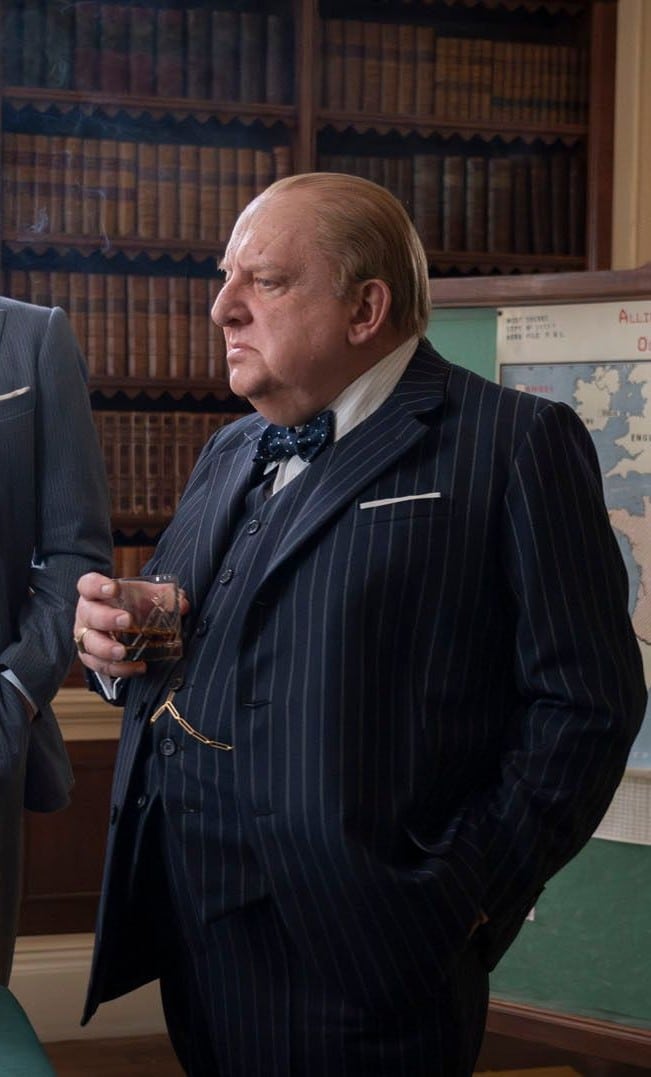
Lambert Wilson plays de Gaulle in the 2020 movie, Tim Hudson plays Churchill. Simon Russell Beale plays him in this recent movie, French-Armenian actor Simon Abkarian (see featured image)) plays De Gaulle. The actors were equally good in both, but as lookalikes …..you be the judge.